
Harris Hagan Harris Hagan
  • Home
  • About
  • People
  • Work
    • Gambling
      • Online gaming
      • Land-based gaming
      • Licensing
      • Compliance
      • Enforcement
      • Training
    • Commercial & Corporate
  • Recognition
  • Blog
  • Contact
Harris Hagan

Marketing

Home / Marketing
05Jul

White Paper Series: Gambling sponsorship of sport – a modern endemic or just the weapon du jour in political warfare?

5th July 2023 Chris Biggs Marketing, White Paper 362

Twenty years after the first partnership between a Premier League football team and a gambling company, the Premier League clubs released a statement on 13 April 2023 confirming that they had “collectively agreed to withdraw gambling sponsorship from the front of clubs’ matchday shirts…” with the aim to reduce the prominence of gambling sponsorship in the Premier League from the end of the 2025/26 season (the “Voluntary Ban”).

Two weeks later, the UK Government released its White Paper High stakes: gambling reform for the digital age, in which the Government commended the Voluntary Ban and also endorsed the creation of a new cross-sport gambling sponsorship code (the “Sponsorship Code of Conduct”) to ensure sponsorship deals are socially responsible.

Critically, however, the White Paper did not – despite calls to the contrary from anti-gambling campaigners – ban gambling sponsorship of sports. For many, this raised eyebrows and prompted the question: did the Premier League and the Government go far enough?

Some say not. Indeed, in the most recent survey by the Football Supporters Association (the “FSA”), 73.1% (nearly three quarters) of respondents agreed with the statement:

“I am concerned about the amount of gambling advertising and sponsorship in football.”

In this White Paper Series blog, we delve deeper into the Voluntary Ban and the Sponsorship Code of Conduct and consider the effectiveness of these methods of self-regulation.

1. Background

The liberalisation of gambling advertising was one of the major changes introduced by the Gambling Act 2005 (the “2005 Act”). Before the 2005 Act, only bingo and lotteries were permitted to advertise on television. Since then the landscape has shifted significantly and gambling marketing, including by means of sponsorship, has become both highly visible and lucrative. Gambling brands provided 12% of sports sponsorship revenue according to a 2019 estimate.

Aside from horse racing and greyhound racing, which have integral links to betting, gambling sponsors are most strongly present in top-tier football, where 8 out of 20 Premier League teams in the 2022/23 season had a front-of-shirt gambling sponsor and all teams had an ‘official betting partner’. In smaller sports such as darts and snooker, a substantial amount of sponsorship revenue also comes from gambling operators.

Potentially as a result of its visibility and the associated revenue, the questions on sponsorship in the call for evidence published by the Government in preparation for its production of the White Paper attracted a high number of responses, with strongly polarised views. Industry stakeholders (as well as representatives of sectors that benefit from gambling advertising, such as broadcasters and sports governing bodies) broadly took the view that the current regulatory regime was fit for purpose. These respondents also emphasised the contributions that gambling revenue makes to other sectors.

In contrast, many other respondents (particularly across the health, charity and academic sectors) argued that gambling advertising was in need of significant reform, with several stakeholders in this group advocating a complete sponsorship ban. Many of these responses expressed concern regarding the link between sports and gambling and a common theme was the need for a ‘precautionary’ approach to the regulation of advertising, arguing that the absence of evidence of harm must not be treated as evidence of an absence of harm.

In the end, the Government concluded that although the limited high‑quality evidence they received on sport sponsorship indicated that it does have a level of impact on gambling behaviour, this was not as marked as for other forms of marketing (such as seeing gambling advertising online or receiving direct marketing) and it was these latter advertising mediums that should be subject to reform following consultation – and we will discuss the proposed reforms in these areas in a later blog. 

Returning to sports sponsorship, the White Paper commended the steps taken voluntarily by the industry and other regulators to date, including the Voluntary Ban, sports governing bodies’ agreement to adopt the Sponsorship Code of Conduct and the introduction of the strong appeal test by the Advertising Standards Authority (the “ASA”); as well as the ASA’s recent high profile enforcement action in relation to the strong appeal test (which we have previously discussed) – but did not recommend the introduction of any more draconian measures to curb the prevalence of gambling sponsorship of sports.

The Voluntary Ban and the Sponsorship Code of Conduct appear therefore to have been well-timed pre-emptive strikes for self-regulation, but will they go far enough?

2. Voluntary Ban – the toothless tiger?

It is without doubt that the Voluntary Ban is a positive step in the right direction by the Premier League. The reduction of children’s exposure to gambling by way of sponsorship, advertising or otherwise is, as the Secretary of State Lucy Frazer noted in her speech to Parliament unveiling the White Paper, a key motivation of both sides of Parliament and the industry as a whole:

“We must do more, which is why we are taking steps to make gambling illegal, in many forms, for under-18s. I welcome the Premier League’s announcement on banning gambling advertising from the front of shirts. Footballers are role models for our children, and we do not want young people to advertise gambling on the front of their shirts…”

The Government’s decision not to recommend further measures to reduce gambling sponsorship of sports (and specifically, football) has not, however, come without scepticism. During the unveiling of the White Paper, several members of Parliament questioned the effectiveness of the Voluntary Ban and criticised the Government’s decision not to take further action. Below we consider some of these arguments and ask whether the Voluntary Ban has actually gone far enough.

First and foremost, it is undeniable that the Voluntary Ban will, once it is implemented, be an important step in reducing the prevalence of gambling advertising to children, for example in football sticker albums that are directly marketed to children. However, the ban does not come into force until the end of the 2025/26 season (theoretically permitting three more football seasons and associated sticker collections with front of shirt sponsorship, at the time of writing) and even when it does come into force, the Voluntary Ban does not extend to the backs of matchday shirts nor other parts of the playing kit. Indeed, the sceptics amongst us will probably expect to see a sea of sleeves adorned with gambling logos in 2026/27.

The second point to note is that shirts (front or otherwise) really are the tip of the iceberg of gambling sponsorship. In the absence of significant reform (for example, in the Sponsorship Code of Conduct, discussed below), we can expect to continue to see gambling sponsorship on pitchside hoardings and structures within football stadiums that are visible to the crowd and/or those watching the match broadcast on television or online.

Thirdly, the Voluntary Ban applies to the Premier League only – lower divisions in the English Football League will be free to continue to accept sponsorship, including on the fronts of shirts – from gambling operators if they choose.

The final argument raised during the Parliamentary debate was that, without a firm stance from the Government, the Premier League could change its tune and reduce the extent of the Voluntary Ban or reverse it entirely. This is of course, an inherent risk of advocating reform by means of self-regulation by an industry – the industry retains control but this risk is countered by the fact that self-regulation is invariably the quickest method to achieve change. During the debate, the Government countered the possibility that the Premier League would subsequently change its position with the reassurance that it “made position very clear to the Premier League” regarding the action it ought to be taking, and it will take any further steps as necessary in the event of further research into the issue.

3. Make the code, not war

In comparison, the Sponsorship Code of Conduct remained largely outside the focus of the Parliamentary debate surrounding the White Paper’s publication.

This may be because the White Paper is rather vague on the scope of the Sponsorship Code of Conduct. Although it recommends that the new code will be common to “all sports” apart from greyhound and horseracing, we do not yet know what this will mean in practice. Will motorsports or esports be included, for example?  Instead, the White Paper simply states that:

“Sports bodies need to ensure a responsible approach is taken to gambling sponsorship through the adoption of a Code of Conduct which will be common to all sports. For individual sports we believe that sports governing bodies are best placed to drive up standards in gambling sponsorship, recognising their specific context and responsibility to their fans. We welcome the work that is underway through sports governing bodies to develop a gambling sponsorship Code of Conduct, and will continue to support its development and implementation across the whole sporting sector…

…The measures included in a sponsorship Code need to be robust enough to provide meaningful improvements in the social responsibility of gambling sponsorships, while giving flexibility to accommodate the material differences between sports.”

The Government goes on to set out some possible principles to be included in the Sponsorship Code of Conduct:
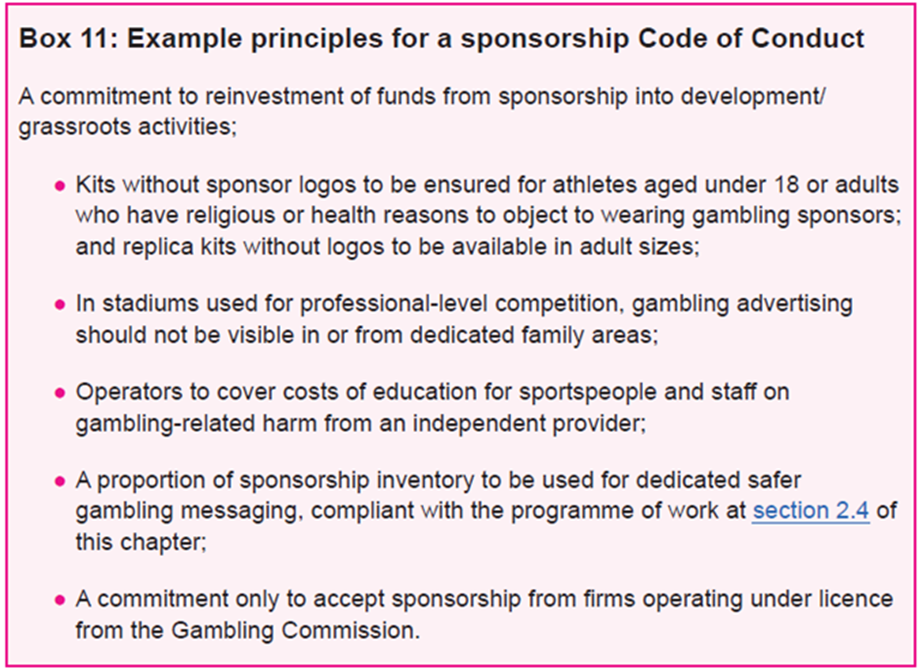
Until we see the draft Sponsorship Code of Conduct, we will not know what impact, if any, it will have on current sponsorship arrangements. Certainly, a couple of the principles suggested in the White Paper appear to go no further than current requirements. By way of example:

(a) it is an offence under the 2005 Act to advertise unlawful gambling, including by means of sponsorship arrangements, and this offence carries a maximum sentence of imprisonment for a term not exceeding 51 weeks and a maximum fine of £5,000 (at the time of writing). If the possibility of committing a criminal offence is not a deterrent against accepting sponsorship from a gambling operator that is not appropriately authorised by a Gambling Commission licence, a commitment to a sports governing body under a voluntary Code of Conduct is unlikely to carry much additional weight; and

(b) operators are already required to follow relevant industry codes on advertising, notably the Industry Code for Socially Responsible Advertising, which provides that:

“advertising of adult-only gambling product suppliers should never be targeted at children….and this Industry Code continues to require that gambling operators do not allow their logos or other promotional material to appear on any commercial merchandising which is designed for use by children. A clear example of this would be the use of logos on children’s sports’ shirts.”

Lastly, it is currently unclear when the Sponsorship Code of Conduct will (1) be published; and (2) come into force. In terms of a timeline, the White Paper simply states that the Government will:

“work with sports bodies to refine the code over the coming months.”

Given the Government’s repeated promises that the White Paper (which took nearly 30 months to be published following the call for evidence) would be published in “the coming weeks”, many will be wary regarding this statement and likely, rightly so.  Not only has the Government committed itself to maintain involvement in the process of agreeing the Sponsorship Code of Conduct (which may slow it down) but the new code must also be reviewed, approved and adopted by governing bodies across “all sports”. We for one, do not envy the person responsible for overseeing such a mammoth task.

4. Our final thoughts…for now

Ultimately, we have again been delivered the message to “hurry up and wait” by the White Paper.  Until the Voluntary Ban comes into force and the Sponsorship of Code of Conduct is adopted across all sports (whenever that might be), it is likely that gambling sponsorship will continue to be the subject of keen debate in the press, politics and beyond. Indeed, in recent weeks, several Premier League Clubs have been caught in the crossfire and criticised for continuing to accept front of shirt sponsorship from gambling operators, even though the Voluntary Ban does not come into force until 2025/26. 

When it does come in, there are also concerns that the Voluntary Ban may not significantly reduce the visibility of gambling brands in major sports – but is this really the issue that the press and politicians are making of it? Some may argue that gambling sponsorship is simply the weapon du jour in the ongoing political warfare surrounding gambling. The White Paper, which sought to be evidence-based, concluded that the limited evidence on gambling sponsorship considered by the Government revealed that sponsorship has a limited effect on gambling behaviour. So, does it really need to be curbed and if it does, what will be the real financial impact of this on sports clubs, some of which currently derive a significant proportion of revenue from gambling sponsorship?

In our view, the key question will be whether the Sponsorship Code of Conduct can find the balance that the White Paper, and most of the industry, seeks. If it is well-considered and efficiently implemented, the Sponsorship Code of Conduct may yet prove itself to be an example of effective self-regulation. But to achieve this, sports governing bodies must strike a balance between (a) reducing the commercial practices that unduly increase the risk of exposure of gambling to children on the one hand, and (b) on the other, permitting gambling sponsorship – along with the financial injection that it brings – safely for the benefit of all levels of sport.

With credit and sincere thanks to Gemma Boore for her invaluable co-authorship.


A recent study by Djohari et al. (2021) on the visibility of gambling sponsorship in football related products marketed directly to children revealed that gambling logos were visible, largely on the front of the shirts, in 42% of the stickers 2020 Panini Premier League sticker album.

Read more
30Jun

Judgement by the company you keep: Licensees’ responsibilities for third parties

30th June 2023 Chris Biggs Anti-Money Laundering, Harris Hagan, Marketing, Responsible Gambling 376

On 19 June 2023, the Gambling Commission released its new hub addressing licensees’ responsibilities for third parties (the “Hub”). In its announcement, the Gambling Commission explained that the Hub sets out its expectations and requirements for licensees which enter into business relationships with third parties. This includes white label and other unlicensed partners.

The announcement comes as a warning to licensees who contract with third parties. There is a strong undertone of compliance in the announcement, reminding the industry that the Gambling Commission’s release of the Hub follows its recent “enforcement action against operators for failures related to due diligence checks on third parties.”

What is included in the Hub?

Primarily, the Hub sets out the Licence Conditions and Codes of Practice (“LCCP”) including social responsibility code provisions (“SRCP”) that impose obligations on licensees relating to their business with third parties.

SRCPs

The Hub sets out the following relevant SRCPs:

SRCP 1.1.2 Responsibility for third parties – all licences

This SRCP applies to all licensees who contract with third parties for the provision of any aspect of their business related to their licensed activities, and makes clear that they are responsible for third parties. It also requires licensees to ensure any contracted third parties conduct themselves, in so far as they carry out activities on behalf of the licensees, as if they were bound by the same licence conditions and subject to the same codes of practice.

SRCP 1.1.3 Responsibility for third parties – remote

This SRCP applies to all remote licensees.

The Gambling Commission further explains the requirements imposed on licensees by SRCP 1.1.2. It reiterates that it expects licensees will: (1) conduct adequate due diligence on third parties to “ensure (amongst other things) that they are competent and reliable”; and (2) have sufficient oversight and controls in place to ensure all activities are carried out in accordance with the LCCP.

The Gambling Commission warns that a failure to maintain adequate control of third parties can result in regulatory action against licensees, including suspension or revocation of an operating licence.

White label partnerships

There is limited detail included within the Hub specific to white label partnerships. However, the Gambling Commission importantly reminds licensees that the responsibility for compliance of all B2C gambling websites, including white labels, sits with the licensee and cannot be transferred to any other party. Licensees must know their customers and implement their controls to minimise any risk to the licensing objectives. A failure to do so may bring into question the licensee’s suitability to hold a licence.

The Gambling Commission directs licensees to section 7 of its Compliance and Enforcement report 2019 to 2020 for guidance on how it expects licensees to conduct their white label partnerships.

Early action after the White Paper

Echoing the Gambling Commission’s commitment in its Advice to Government, the White Paper sets out that:

“To ensure all licensees fully understand their responsibilities when entering into such arrangement, the Gambling Commission will consolidate existing information and good practice for operators on contracting with third parties, including white labels.”

Given the Hub was released less than two months after the White Paper, the Gambling Commission will consider this announcement as a box ticked, despite the relatively basic information provided.

Additional requirements or new guidance has not been published. This is, as expected, following the Gambling Commission’s view (as stated in its Advice to Government) that it considers the existing legislative and regulatory framework provides sufficient controls to address the current risks.

The release of the Hub is a timely reminder to all licensees contracting with white labels or other unlicensed third parties for any aspect of their business in Great Britain, that they, as the licensees, are ultimately responsible for the third parties with whom they contract.

Key takeaway

We recommend that all licensees review their policies, procedures and controls relating to third parties, including due diligence processes and contractual agreements to ensure they are fit for purpose and mitigate the risk of regulatory enforcement action, as the Gambling Commission will judge licensees based on the company they keep.  

Please get in touch with us if you would like assistance with any due diligence, compliance or enforcement matters, or any aspect of your business and its arrangements with third parties.

Read more
31May

White Paper Series: “Hurry up and wait”

31st May 2023 John Hagan Anti-Money Laundering, Harris Hagan, Marketing, Responsible Gambling, Training, White Paper 376

As the dust settles (at least temporarily) following the publication of the White Paper, we have “take time to think” so that we may share our insights in a series of blogs and vlogs on the many and varied aspects of the proposed gambling reforms. With the Gambling Commission already seeking to manage expectations by saying that the implementation of the White Paper “will likely take a number of years to fully complete” and urging “more haste, less speed”, this may be a long running series… We will focus on what we consider is important or interesting, ideally both, and our content will be concise and hopefully thought provoking.   

Speaking about the White Paper recently in the House of Lords, Lord Grade referred to a saying in the film industry – “hurry up and wait” (also a song by Stereophonics and a military motto) – describing where you get to the location after being forced to spend a lot of time waiting, everybody is standing around, ready, but nothing happens. Having waited nearly 30 months for the publication of the White Paper, coupled with the latest (estimated) indication from the Gambling Commission that the first wave of consultations will not be seen until mid-July, this saying seems apt.

1. Spirit and intention of the White Paper

Throughout our White Paper Series, we will have as our touchstone the aim of the Gambling Review when it was published on 8 December 2020:

“The Government wants all those who choose to gamble in Great Britain to be able to do so in a safe way. The sector should have up to date legislation and protections, with a strong regulator with the powers and resources needed to oversee a responsible industry that offers customer choice, protects players, provides employment, and contributes to the economy.”

The White Paper is true to that laudable aim. As the Secretary of State says in her Ministerial Foreword, at the heart of the Government’s Review is making sure it has the balance right between consumer freedoms and choice on the one hand, and protection from harm on the other. The Government seeks to achieve this balance through an extensive package of measures across all facets of gambling regulation. If it is to be successful, the Government – and Gambling Commission – will need to retain an unerring focus on this balance, essentially the spirit and intention of the White Paper, as it is inevitably buffeted by vested interests through consultation, regulation, and legislation.

2. All things to all people

The first thing to say about the White Paper is that it has been broadly well received; when it was delivered in Parliament, within all sectors of industry, by the NHS, in the third sector and at the Gambling Commission. This was equally broadly unexpected, given the acrimony and divergence of views between stakeholders during the “hurry up” phase, so why has the White Paper been such a resounding success? At the risk of oversimplifying, but not wishing to overlook the obvious (including the lack of detail and long grass kicking), it is precisely because the Government has achieved a healthy balance in its proposed reforms, for which it deserves enormous credit, and it is because there is something valuable in the White Paper for everyone.

Responding to its publication, and demonstrating some of the “wins” for the respective stakeholders, comments on the White Paper included:

“Given the correct powers and resources, the Gambling Commission can continue to make gambling safer, fairer and crime free. This White Paper is a coherent package of proposals which we believe can significantly support and protect consumers, and improve overall standards in the industry.” Gambling Commission CEO, Andrew Rhodes.

“BGC members will now work with Government and the Gambling Commission to deliver targeted and genuinely ‘frictionless’ enhanced spending checks to further protect the vulnerable, a new Ombudsman to improve consumer redress, and overdue plans to modernise the regulation of UK casinos.” Betting & Gaming Council CEO, Michael Dugher.

“..it should not be left to the health service to pick up the pieces left behind by a billion-pound industry profiting on vulnerable people, so I fully endorse the statutory levy set out in today’s White Paper and look forward to reading the proposals in detail.” NHS Mental Health Director, Claire Murdoch.

“At GamCare, our priority is making sure that people who need help receive it as quickly as possible. We therefore welcome the clarity the Government has provided on how research, education and treatment will be funded.” Gamcare CEO, Anna Hemmings.

“As chair of the all-party parliamentary group on gambling related harm, I welcome this long overdue White Paper. In the APPG’s 2019 interim report, we asked for affordability checks, parity between land-based and online stakes, an independent ombudsman, a curb on advertising and, most importantly, a statutory levy. Job done.” Carolyn Harris MP.

The introduction of a statutory levy paid by licensees and collected and distributed by the Gambling Commission under the direction and approval of the Treasury and DCMS ministers, is a flagship reform. The long debate as to whether there should be a statutory levy is at an end, there will be a DCMS consultation on the details of its design and, critically, the total amount to be raised. The statutory levy will fund research, education and treatment of gambling harms and is a load-bearing pillar of the reforms for those advocating the “polluter pays” principle.

Financial risk checks, maximum stakes for online slots and the creation of an independent gambling ombudsman have also been very warmly received by key stakeholders and will all be consulted upon by DCMS. The new non-statutory ombudsman will be the subject of our next blog in this White Paper Series.

The Gambling Commission most certainly did not get everything its own way, with Government not religiously following the advice from the regulator, but the Gambling Commission will be the recipient of powers and resources intended to make sure that all gambling is overseen by a “beefed up, better funded and more proactive” regulator. Licence fees will be reviewed (upwards of course) to ensure it has the resources to deliver the commitments across the White Paper. When Parliamentary time allows, it will even get greater power to set its own fees. Detailed analysis of the Gambling Commission’s additional enforcement powers will be the subject of one of our early blogs in this White Paper Series, including some which may have passed below the radar in all the excitement.

The industry positives from the White Paper are more nuanced. The land-based industry can certainly look forward to the long overdue modernisation of casinos and bingo clubs – including greater machine entitlements, credit in casinos for non-UK resident customers, sports betting in all casinos, and additional opportunities for customers to win on the main stage bingo game – and cashless payments across all land-based gambling sectors (following consultation by the Gambling Commission on the player protections which would be required).

From an online industry perspective, the White Paper is arguably as good as could reasonably have been expected in the present political, media and regulatory environment. The Government has resisted calls for bans on advertising, rejected demands for blanket and intrusive low-level affordability checks, and will consult on maximum stakes for online slots at higher levels than leaked previously. However, in outlining the Government’s vision for the future of gambling in moderately business-friendly terms, the White Paper does provide policy direction to which to hold the Gambling Commission accountable, the beginnings of some certainty and a glimpse of what political and regulatory stability might look like, not to mention the hope that the next gambling review might be a generation away.

3. The upcoming consultations

Yes of course everyone wishes the White Paper had gone further (in their direction, naturally). Yes of course there is a lot of work to be done to implement the reforms, once we are no longer “waiting”. Yes of course the devil will be in the detail. But as even the Gambling Commission and the Betting and Gaming Council (the “BGC”) agree in their welcoming press releases, the White Paper is a “once in a generation” opportunity for change. All the key stakeholders will now be seeking to secure their respective prize and imploring Government to prioritise their interests and deliver on its promises at the earliest opportunity, not least through Government and Gambling Commission consultations.

If the risk of the reform process descending into warring factions and reaching a standstill is to be mitigated, and this would not be in anybody’s interests, it is imperative that the process itself remains balanced and that all the key stakeholders see comparable progress in relation to their interests. From an industry perspective, this means engaging positively, constructively, and wholeheartedly with the upcoming consultations, proposing pragmatic and sensible solutions to the difficult challenges the Government and the Gambling Commission face, not least in relation to cashless solutions and frictionless checks, substantiated by evidence wherever possible. It also means holding the Gambling Commission to account on what is expected of it by the Government in the White Paper, with fair prioritisation of its (no doubt stretched) resources and no reforms being left far behind, even when the Gambling Commission is not in favour of them. It means focusing on its prize and not seeking to “re-litigate” settled issues or actively seeking to frustrate other stakeholders, or indeed otherwise antagonising Government which has delivered upon a balanced vision.   

The proposed reforms are going to take longer than any of the stakeholders want as they seek to claim their prizes, but they are worth waiting for, the consultation phase will be critical, with both Government and the Gambling Commission under immense pressure to listen, and we will of course be happy to assist clients with their responses where that would be helpful, as we did in the last once in a generation opportunity in 2005!

Read more
28Apr

Gambling Commission Advice to Government

28th April 2023 Harris Hagan Anti-Money Laundering, Harris Hagan, Marketing, Responsible Gambling, White Paper 331

The Gambling Commission has published its advice to Government (the “Advice”), as part of the review of the Gambling Act 2005 terms of reference and call for evidence, providing advice on each of the following topics:

  • effectiveness of the regulatory system;
  • online protections, players and products;
  • safer gambling and public health messaging;
  • advertising, marketing and sponsorship;
  • the Commission’s powers and resources;
  • wider funding for research, prevention and treatment;
  • consumer redress;
  • age limits and verification;
  • protections for young adults; and
  • land-based gambling.

In the Introduction, the Gambling Commission explains:

“In forming our advice, we have considered the widest range of evidence and applied a rigorous, consistent, and transparent evidence assurance process. The evidence assurance process enabled us to determine the strength of the evidence base and the weight that could be applied to the formulation of our recommendations. Where there was a lack of conclusive evidence, we took the position that this did not automatically mean that conclusions could not be reached or that action should not be taken. In some of our recommendations we have applied the precautionary principle where the potential for harm existed. We have, however, been transparent in our advice where we are advocating a precautionary approach.”

Andrew Rhodes, Gambling Commission CEO, said:


“The gambling industry has changed significantly since 2005 and our advice sets out changes that will ensure Britain is the safest and fairest place to gamble in the world. The review is a once-in-a-generation opportunity to deliver positive change for gambling in Great Britain and for all people impacted by it. Everyone at the Commission welcomes today’s publication of the White Paper and is determined to work with Government and partners to make these changes a reality. Given the correct powers and resources, the Gambling Commission can continue to make gambling safer, fairer and crime free. This White Paper is a coherent package of proposals which we believe can significantly support and protect consumers, and improve overall standards in the industry. As the detailed implementation of the review now begins, we will also be reiterating to all operators that the Commission will strongly maintain its focus on consumer protection and compliance.”

The Advice was published very shortly after the long-awaited publication of the Gambling White Paper on 27 April 2023.

We will review the Advice in detail and will be publishing our insights over the coming weeks and months.

Download the Advice to Government
Read more
10Nov

The Legal 500 Country Comparative Guide 2022 – Gambling Law

10th November 2022 Adam Russell Anti-Money Laundering, Harris Hagan, Marketing, Responsible Gambling, Training 342

Partner Bahar Alaeddini acted as the contributing editor, and together with Associate Francesca Burnett-Hall jointly contributed the UK chapter, to The Legal 500: Gambling Law Comparative Guide (the “Guide”).

UK ChapterDownload

The esteemed publication (which currently spans 16 jurisdictions) provides an overview of gambling law, regulatory and licensing requirements in the UK, including: key gambling legislation; types of gambling licences with the associated application procedures; prohibited gambling products; gambling advertising; marketing affiliates; penalties for unlawful gambling; Licence Conditions and Codes of Practice; relevant anti-money laundering requirements; responsible gambling requirements; shareholder reporting and approval thresholds; enforcement powers; and tax rates. A critical commentary on key trends affecting the gambling industry is also covered.

The Guide provides readers with the opportunity to compare jurisdiction here.

Read more
21Sep

New remote customer interaction requirements take effect…in part

21st September 2022 David Whyte Anti-Money Laundering, Marketing, Responsible Gambling 336

On 12 September 2022, the Gambling Commission’s new Social Responsibility Code Provision (“SRCP”) 3.4.3, partly came into effect. For now, however, the Customer interaction guidance – for remote gambling licensees (Formal guidance under SR Code 3.4.3 (the “Guidance”) will not take effect.

Background

In its update of 2 September 2022, the Gambling Commission states that the delay in the implementation of parts of SRCP 3.4.3, and the Guidance, takes into account a request from the industry for “an extension to the timeframe for implementing these new measures”. Further, it “considers it would be beneficial to use the time now available to conduct further consultation on matters to be addressed in the guidance associated with SR Code 3.4.3 by way of a consultation on the guidance document itself”: something which, as we pointed out in July, it should have done in the first place.

The Gambling Commission describes the Guidance as a “living document which is intended to be amended over time”: we have previously set out our concerns about the Gambling Commission’s introduction or amendment, without consultation, of guidance that has the effect of a licence condition. The Gambling Commission states it is “particularly interested to hear about good practice in implementing the requirements, based on the lessons learned by operators during the period between April and September and to hear about any implications arising out of recent research, evidence and casework”. A cynic may suggest that its focus on good practice implementation is indicative that, following the consultation, any revised guidance issued is likely to be very similar to the Guidance, irrespective of any consultation responses submitted: a cycle that has become commonplace in recent times.

The Gambling Commission states that the consultation is “set to be launched during late September and will last six weeks” (rather than the usual 12). Its provisional intention is to “publish the guidance on requirements in December 2022 with it taking effect approximately 2 months after publication”. Whether it meets that deadline remains to be seen.

We strongly encourage all licensees to respond to the Consultation when it is launched.

The Guidance – delay and confusion

The Gambling Commission’s decision, at this late stage, to delay implementation of parts of SRCP 3.4.3 and consult on the Guidance is surprising, as is the fact that pending its consultation it will not require that remote licensees take into account any guidance whatsoever. It seems to us that the latter of these issues has largely been influenced by two factors. Firstly, the fact that the previous Customer interaction: formal guidance for remote gambling operators (the “Previous Guidance”) was issued under the old SRCP 3.4.1, which is also now no longer in effect. Secondly, the Gambling Commission is unable to amend the new SRCP 3.4.3 and require that licensees adhere to the Previous Guidance without further consultation.

This last-minute change creates a lacuna that will last until at least February 2023, which will confuse some remote licensees and infuriate others. Remote licensees are left in the unenviable position of being without any customer interaction guidance whatsoever at a time when, by its recent admission, the Gambling Commission’s “focus on customer interaction has been there for some time now and will certainly be continuing over the coming months”. There must surely also be a risk that consumers could be negatively impacted due to this lack of clarity.

The Guidance – fairness and reasonableness

It has been a requirement that remote licensees “take into account the Commission’s guidance on customer interaction” since 31 October 2019. As any licensee who has been subject to a compliance assessment or regulatory action will attest, in practice the Gambling Commission interprets “take into account” as “strictly adhere to”. This is clear not only from the actions of the Gambling Commission, but also from the affirmative language, such as “must” and “required”, that is contained in guidance it has issued in relation to customer interaction. The Previous Guidance has therefore, at least to some extent, had the effect of a licence condition.

Various regulatory sanctions have been imposed, or regulatory settlements agreed that can be linked, at least in part, to remote licensees’ failure to take into account the Previous Guidance. Those licensees may, rightly, feel aggrieved that a combination of convenient timing and poor regulatory governance, means that they were exposed to such sanctions when, contrastingly, their peers, who may be subjected to compliance assessments or regulatory action now, are no longer obliged to adhere to similar standards. Whether those licensees choose to challenge this unfairness remains to be seen and may depend on the Gambling Commission’s action during this hiatus.

Non-remote licensees remain subject to the requirement, by virtue of SRCP 3.4.1, to “take into account the Commission’s guidance on customer interaction”. This guidance, Customer interaction: formal guidance for premises-based operators (the “Non-remote Guidance”), sets out very similar requirements to the Previous Guidance. This difference in required standards is likely to aggravate non-remote operators, particularly if the Gambling Commission continues to take action against them based on a failure to take into account the Non-remote Guidance.  They will also likely be concerned that their already diminishing pool of customers will continue to migrate to the remote sector, which, at least in the short term, is held to a lower standard or can justify non-compliance more easily.

We question whether the Gambling Commission has given adequate thought to the possible impact of this last-minute U-turn and the consequential risk of challenge:

  • What will the position be for those licensees currently subject to regulatory action for failing to adhere to the Previous Guidance, or for those subjected to a compliance assessment in a period that straddles the change? What standards will they be held to?
  • Will the Gambling Commission now expect licensees to adhere only to the literal wording of SRCP 3.4.3, ignoring not only the delayed Guidance but also the Previous Guidance?
  • What are the current affordability requirements? Those requirements, in particular the requirement to consider ONS data and national average salaries when assessing affordability, were set out in the Previous Guidance and repeated in the Guidance. On what basis does the Gambling Commission propose to hold remote licensees who fail to meet those standards to account during this period?

The Gambling Commission has almost certainly opened a can of worms through this seemingly haphazard change. Licensees, consumers, stakeholders, and Government are all likely to have varying concerns. Whilst it is pleasing to see that the Gambling Commission has identified the risks linked to bringing all the requirements under SRCP 3.4.3 and the Guidance into effect without consultation, these issues could have been avoided if the Gambling Commission had given earlier credence to comments made by licensees, or industry stakeholders and advisors. The lateness of this change is embarrassing and the consequential complexities that now follow should be carefully navigated or the Gambling Commission may be exposed to challenge.

Next steps and SRCP 3.4.3

It is the Gambling Commission’s intention, subject to consultation, to introduce the remaining requirements of SR Code 3.4.3 and the associated guidance on 12 February 2023.

In the meantime, we encourage remote licensees to ensure that their policies, processes, and procedures comply with the existing requirements.

To assist licensees, we set out below SCRP 3.4.3 with deletions for those requirements not brought into effect on 12 September 2022.

Customer interaction 

All remote licences, except any remote lottery licence the holder of which does not provide facilities for participation in instant win or high frequency lotteries1, remote gaming machine technical, gambling software, host, ancillary remote bingo, ancillary remote casino, ancillary remote betting, remote betting intermediary (trading rooms only) and remote general betting limited licences.

  1. Licensees must implement effective customer interaction systems and processes in a way which minimises the risk of customers experiencing harms associated with gambling. These systems and processes must embed the three elements of customer interaction – identify, act and evaluate – and which reflect that customer interaction is an ongoing process as explained in the Commission’s guidance (see paragraph 2).
  2. Licensees must take into account the Commission’s guidance on customer interaction for remote operators as published and revised from time to time (‘the Guidance’). 
  3. Licensees must consider the factors that might make a customer more vulnerable to experiencing gambling harms and implement systems and processes to take appropriate and timely action where indicators of vulnerability are identified. Licensees must take account of the Commission’s approach to vulnerability as set out in the Commission’s Guidance.
  4. Licensees must have in place effective systems and processes to monitor customer activity to identify harm or potential harm associated with gambling, from the point when an account is opened. 
  5. Licensees must use a range of indicators relevant to their customer and the nature of the gambling facilities provided in order to identify harm or potential harm associated with gambling. These must include: 
    • customer spend
    • patterns of spend
    • time spent gambling
    • gambling behaviour indicators 
    • customer-led contact 
    • use of gambling management tools
    • account indicators.
  6. In accordance with SR Code Provision 1.1.2, licensees are responsible for ensuring compliance with the requirements. In particular, if the licensee contracts with third party business-to-business providers to offer any aspect of the licensee’s business related to the licensed activities, the licensee is responsible for ensuring that systems and processes are in place to monitor the activity on the account for each of the indicators in paragraph 5 (a-g) and in a timely way as set out in paragraphs 7 and 8.
  7. A licensee’s systems and processes for customer interaction must flag indicators of risk of harm in a timely manner for manual intervention, and feed into automated processes as required by paragraph 11. 
  8. Licensees must take appropriate action in a timely manner when they have identified the risk of harm. 
  9. Licensees must tailor the type of action they take based on the number and level of indicators of harm exhibited. This must include, but not be limited to, systems and processes which deliver:
    • tailored action at lower levels of indicators of harm which seeks to minimise future harm
    • increasing action where earlier stages have not had the impact required
    • strong or stronger action as the immediate next step in cases where that is appropriate, rather than increasing action gradually
    • reducing or preventing marketing or the take-up of new bonus offers where appropriate
    • ending the business relationship where necessary. 
  10. Licensees must prevent marketing and the take up of new bonus offers where strong indicators of harm, as defined within the licensee’s processes, have been identified.
  11. Licensees must ensure that strong indicators of harm, as defined within the licensee’s processes, are acted on in a timely manner by implementing automated processes. Where such automated processes are applied, the licensee must manually review their operation in each individual customer’s case and the licensee must allow the customer the opportunity to contest any automated decision which affects them.
  12. Licensees must implement processes to understand the impact of individual interactions and actions on a customer’s behaviour, the continued risk of harm and therefore whether and, if so, what further action is needed.  
  13. Licensees must take all reasonable steps to evaluate the effectiveness of their overall approach, for example by trialling and measuring impact, and be able to demonstrate to the Commission the outcomes of their evaluation.
  14. Licensees must take account of problem gambling rates for the relevant gambling activity as published by the Commission, in order to check whether the number of customer interactions is, at a minimum, in line with this level. For the avoidance of doubt, this provision is not intended to mandate the outcome of those customer interactions.
Read more
05Jul

Lexology – Getting the Deal Through, Gaming 2022

5th July 2022 Harris Hagan Anti-Money Laundering, Harris Hagan, Marketing, Responsible Gambling 390

As Harris Hagan continues its contribution to the Lexology GTDT Gaming publication, we are pleased to share with our subscribers, complimentary access to the full reference guide which is now available online.

Our Associate, Jessica Wilson, remains the author of the United Kingdom report, which covers a range of British regulatory insights including land-based and remote gambling and quasi-gambling activities, including legal definition; anti-money-laundering regulations; director, officer and owner licensing; passive/institutional ownership; responsible gambling; taxes; advertising; supplier licensing and registration; change of control considerations; and recent trends in the industry.

The reference guide also allows for side-by-side comparisons with other local insights from jurisdictions such as Australia, Brazil, Germany, Hong Kong, Japan, Macau, Nigeria, South Africa and the USA.

We invite you to review the reference guide at your leisure.      

Read more
28Feb

Chambers Global 2022 – Four Lawyers Ranked

28th February 2022 Ting Fung Harris Hagan, Marketing 333

Harris Hagan continues to have four lawyers individually ranked for Chambers & Partners’ Global Market Leaders Rankings (Gaming & Gambling).

As always, we are proud to have the quality of our work in the gambling industry recognised by the prestigious legal directories and will always strive for the highest standards.

Julian Harris (Band 1), was recognised as one of the leading gaming specialists in the UK and venerated for his “considerable experience advising on multi-jurisdictional gaming and gambling matters.”

John Hagan (Band 1), was recognised as having “significant expertise” advising “leading gaming and gambling clients on complex regulatory matters”, for which market sources have praised him as being “absolutely excellent”.

Bahar Alaeddini (Band 2) has been exalted for her “considerable strength” advising clients on a broad spectrum of regulatory and licensing complexities. 

Last but certainly not least, Hilary Stewart-Jones occupies the esteemed position of Senior Statesperson. Commentary has emphasised her status as being both “well-respected” and “international”, with wide-ranging transactional and regulatory experience.

Read more
06Jan

Gambling Commission Compliance and Enforcement Report 2020-2021

6th January 2022 Ting Fung Anti-Money Laundering, Marketing, Responsible Gambling 367

The Gambling Commission’s latest Raising Standards for consumers – Compliance and Enforcement report 2020 to 2021 (the “Report”) was published on 9 December 2021, the first since Neil McArthur’s departure, and details “one of the busiest for Enforcement and Compliance teams…”. Unsurprisingly, the focus of the Report remains on social responsibility and anti-money laundering failings. It also includes designated sections on licensed operators and financial stability, special measures and licence suspensions, personal management licence (“PML”) reviews and illegal gambling. However, surprisingly, and unlike the Raising Standards for consumers – Compliance and Enforcement report 2019 to 2020, affordability is not featured as a key theme despite the continuing and increasing focus by the Gambling Commission across its compliance enforcement work.

Certainly, this is reflected in the Gambling Commission’s summary of its compliance and enforcement work:

  • 15 financial penalty packages or regulatory settlements totalling £32.1 million;
  • 262 security audits;
  • 57 personal licence reviews were finalised; and
  • 82 website reviews conducted; and
  • 30 full assessments of online and non-remote operators.

Alongside an acknowledgment of the challenges of the pandemic upon consumers and businesses, the foreword concludes that:

“Looking back at enforcement in 2020 to 2021 we see the same two weaknesses in almost every case – operators failing to adhere to social responsibility and anti-money laundering rules…The reasons for these failings are almost as concerning as the failings themselves. Our casework reveals that operators are either not making suitable resources available or are simply putting commercial objectives ahead of regulatory ones…As the Great Britain’s regulator for the gambling industry, we still see far too many breaches of regulations where everyone in the industry agrees we should not see them. The industry has the resources, skills and knowledge to change this.”

We strongly encourage applicants and licensees to review, carefully, the Gambling Commission’s identified common poor practices, case studies, notable enforcement cases, guidance and lessons learned and health-check good practices.

Summary of other key areas from the Report:

Anti-money laundering and counter terrorist financing

“The Commission is finding increasing instances of gambling operators failing to consider how problem gambling can be linked to ML and TF despite both the Commission’s Guidance for remote and non-remote casinos: The prevention of money laundering and combating the financing of terrorism and Duties and responsibilities under the Proceeds of Crime Act 2002: Advice to operators (excluding casino operators) stating:

a pattern of increasing spend or spend inconsistent with apparent source of income could be indicative of money laundering, but also equally of problem gambling, or both.”

The common poor practices which led to “avoidable failings” were cited as:

  • inadequate due diligence measures;
  • failure to account for the Gambling Commission’s various guidance documents;
  • failure to consider the full range of circumstances in which enhanced due diligence (“EDD”) is to be applied;
  • over reliance on third party providers to conduct due diligence (“CDD”) checks;
  • delayed customer identification checks;
  • commercial considerations overriding the need to comply with anti-money laundering (“AML”) and counter-terrorist financing (“CTF”) provisions;
  • operators having no clear methodology in place in their money laundering (“ML”) and terrorist financing (“TF”) risk assessments;
  • vague references made in ML and TF assessments;
  • not considering how problem gambling can be linked to ML and TF;
  • high financial thresholds in place before CDD or EDD measures take place;
  • high financial thresholds based on losses, deposits, or winnings only; and
  • the ML/TF risk assessment not being fully used to inform policies, procedures and controls.

The Gambling Commission highlighted the need for licensees to:

  • apply a risk-based approach;
  • conduct robust CDD and EDD checks;
  • ensure that their ML/TF risk assessment along with their policies, procedures and controls sufficiently mitigate the risk of ML and TF;
  • ensure that they are compliant with and stay up to date on customer interaction requirements, and that they take account of the current formal guidance for their sector; and
  • deliver robust and up to date employee training.

Licensed operators and financial stability

“It is not surprising given the significant challenges the pandemic has posed globally, that we have observed a significant increase in gambling operators, particularly land-based operators, experiencing extreme financial difficulty. In such situations it is imperative that operators, and their representatives are mindful of what is required of them in relation to the Licensing Objectives and customer protections. We urge licensees who are encountering financial stability issues to engage with the Commission at an early stage.”

Key takeaways from this section are:

  • responsibility for regulatory compliance remains – at all times – on the licensee, whether this is the gambling business or an appointed administrator;
  • in the case of administration, all regulatory responsibilities continue and vest in the administrator; and
  • operating licensees and PMLs were reminded the Gambling Commission will remain focused on ensuring licensees are treating consumers fairly. Fair treatment includes but is not limited to ensuring that segregated funds with medium and/or high-risk customer protection measures are ring fenced and not used to pay business expenditure.

The unsurprising consequence of either improper closedown or not adhering to continuing regulatory responsibilities are risks to any continuing operating licences PMLs. The Gambling Commission further emphasised that any adverse outcomes “may” affect future applications both in Great Britain and with other regulators abroad.

Special measures

As part of its regulatory toolkit, the Gambling Commission has been piloting the use of special measures, since September 2020, “to bring operators to compliance at pace” following the identification of failings during a compliance assessment. 

During the special measures process a licensee makes various commitments to, and is supervised by, the Gambling Commission in “a closely managed and monitored timetable to achieve compliance over a relatively short period of time.”  Wide-ranging, significant and immediate improvements are required to the licensee’s policies, procedures and controls, generally, within a challenging timeframe.  Once the Gambling Commission is satisfied improvements have been made and there is no risk to the licensing objectives, particularly consumers, the special measures will be lifted.

The Report highlights that the pilot scheme has used in relation to eight licensees.  The Gambling Commission has found special measures highly effective in incentivising licensees to make quick and substantial improvements (and divestments!) to avoid a licence review, and that it why they are being formalised (as noted below). The shared objective of the dangled carrot is to avoid a section 116 licence review, and in the case of the licensee, the uncertainty, huge stress and cost that they bring! 

The Gambling Commission is currently consulting on special measures, to make them a permanent feature of their regulatory toolkit, as part of its consultation on the Licensing, compliance and enforcement under the Gambling Act 2005: policy statement.  Read more about the consultation and special measures process in our blog on 13 December 2021.

PML reviews

“Businesses do not make decisions – people do. This is why the Commission continues to ensure that personal licence holders are held accountable, where appropriate, for the regulatory failings within the operators they manage.”

Key failings identified through casework included:

  • inadequate source of funding or source of wealth checks;
  • record keeping – lack of adequate documentation and audit trails to demonstrate properly informed decision making;
  • reporting criminal offences – delays or failures to report Schedule 7 offences as a key event;
  • nominated officer/ MLRO poor practice; and
  • senior management lacking oversight.

The associated casework has resulted in the following outcomes:

  • 10 licence revocations – eight Personal Functional Licenses (“PFL”) and two PMLs;
  • 11 PML warnings issued;
  • One PML warning with conditions;
  • 21 PML advice as to conducts; and
  • 10 PMLs surrendered.

Illegal gambling

“We are particularly focused on identifying and disrupting websites which are targeted at young or vulnerable people, those who experience significant harms from their gambling and self-excluded gamblers. The most widely reported complaints from members of the public related to the allowance of gambling. This accounted for 62% of all unlicensed remote reporting for the financial year 2020 to 2021 representing a 17% increase compared to the financial year 2019 to 2020.”

There were 99 reports of unlicensed remote operators in the financial year 2020 to 2021, some of which accounted for the same illegal website. In addition:

  • consumers’ inability to withdraw funds remained a prevalent issue;
  • there was a rise of illegal lotteries on social media;
  • the Gambling Commission continues to work with social media outlets and other regulators internationally to counteract the risks posed by illegal lotteries;
  • the Gambling Commission is also assessing its need for further legislative powers to counteract illegal gambling and will report any conclusions to the Department of Culture, Media and Sport as part of the Gambling Review.

What’s next?

The Gambling Commission’s foreword concludes that:

“The reasons for failings are almost as concerning as the failings themselves. Our casework reveals that operators are either not making suitable resources available or are simply putting commercial objectives ahead of regulatory ones.

This is simply unacceptable and will be seen as such by others in the industry who work hard to achieve compliance.

…

Our Enforcement and Compliance work will continue to focus on customer protection, as consumers have every reason to expect. This will vary from paying very close attention to novel products to checking that operators are looking after their customers by meeting the LCCP requirement and taking into account the current Commission guidance on anti-money laundering and customer interaction”.

Compliance and enforcement action will continue unabated.

Updated and consolidated guidance on AML and customer interaction is due to be issued “shortly” following the Gambling Commission’s consultation that ended nearly a year ago on 9 February 2021.

We strongly encourage applicants and licensees to review, carefully, the Report and the Gambling Commission’s identified common poor practices, case studies, notable enforcement cases, guidance and lessons learned and health-check good practices.

Read more
24Nov

The Gambling Commission’s First National Strategic Assessment

24th November 2020 Ting Fung Anti-Money Laundering, Harris Hagan, Marketing, Responsible Gambling 445

On 6 November 2020 the Gambling Commission published its first National Strategic Assessment (“NSA”) alongside its annual, Raising Standards for consumers – Compliance and Enforcement report 2019 to 2020.

What is it?

The NSA is a document comprised of the latest available evidence with the aim of assessing the issues and risks associated with gambling related harm. Gambling Commission Chief Executive, Neil McArthur has stated:

“We will use our National Strategic Assessment as the foundation for prioritising our work over the coming months and years.”

In the accompanying press release, Neil McArthur adds:

“We look forward to working with the government on the forthcoming review of the Gambling Act and alongside that work we will be working hard to address the issues that we have identified in our Strategic Assessment.

We have demonstrated that we are willing and able to respond quickly to emerging issues and risks and that we will use the full range of our powers to protect consumers.  We and have made considerable progress in many areas to make gambling safer – but we want to go further and faster.”

The report outlines the Gambling Commission’s assessment of the key issues faced in making gambling fairer, safer and crime free, and sets out the priority actions and an overview of progress that has been made since 2019.

The Gambling Commission acknowledges that whilst neither gambling participation nor problem gambling rates are increasing, the continually evolving landscape of gambling presents new risks and ongoing challenges.  In the Executive Summary the Gambling Commission states:

“We must see the industry doing more to proactively identify and address the risks within their businesses.  An approach to raising standards for consumers which is heavily dependent on the Commission using its formal regulatory powers will continue to damage the industry’s reputation, restrict activities and result in escalating penalties.”

The regulator maintains that the best and most sustainable way forward is for operators to allow the distinction between regulatory and commercial considerations to diminish if not disappear altogether.

How will it work?

The Gambling Commission will use “priority actions” to target relevant risks and issues whilst highlighting areas where significant progress has been made.  Assessment is built on four “pillars” relating to:

  1. the Person gambling (Chapter 1);
  2. the Place gambling occurs (Chapter 2);
  3. the Products available to customers (Chapter 3); and 
  4. the Provider of facilities for gambling (Chapter 4).

The NSA is structured around these pillars, which are coupled with sections on measuring the effectiveness of gambling regulation (Chapter 5), Covid-19 and its impact on gambling consumers (Chapter 6) and the timeline for action (Annex 1).

The NSA is essential reading for any Gambling Commission licensee.  Unsurprisingly, the content is closely aligned to the Compliance and Enforcement Report (see our blog on 18 November 2020), published on the same day, and there is a strong emphasis on affordability (Chapter 1, pages 14-18).  We strongly encourage B2Cs to review this section carefully, particularly figure 7 and the “clearly unaffordable gambling” case studies.

The NSA’s scope of evidence aims to be wide ranging, drawing on:

  • the Gambling Commission’s own compliance and enforcement work;
  • its advisory bodies, the Advisory Board for Safer Gambling as well as the Digital Advisory Panel;
  • the Interim Experts by Experience Group (involving those with direct experience of gambling related harm);
  • industry colleagues and representatives; and
  • the findings of recent Parliamentary reports (see here).

Why now?

Such a document is no doubt in line with the Gambling Commission’s licensing objectives and follows on from regulatory action and research that the Gambling Commission has already performed (see Annex 1 of the NSA for a timeline of action). However, it is also arguable that the speed and depth of their action is partially motivated by the House of Commons’ Public Accounts Committee assessment in June this year that more and faster action was needed by the Gambling Commission to protect vulnerable customers and consumers’ rights to redress. Neil McArthur seems to echo this in his above statement that “ to go further and faster” with its progress.

What to expect next?

The NSA includes numerous “GC actions” throughout.  We have summarised these, by chapter, as follows:

Chapter 1: the Person gambling

In response to the key issues and risks regarding:

  1. ineffective KYC approaches including affordability checks;
  2. delayed and ineffective responses to at-risk behaviours;
  3. inadequate controls for more engaged gamblers;
  4. underage gambling; and
  5. gaps in evidence and understanding of gambling-related harms.

The Gambling Commission proposes to act on the following:

  • Consultations regarding more effective KYC and early identification and effective responses to at-risk behaviour, to include: responding to and implementing the Gambling Commission’s customer interaction consultation on themes of affordability, vulnerability and identifying and acting on harm indicators, including the management of high value customers. In addition, the Gambling Commission will issue a consultation on streamlining the approach to tracking of gambling participation and prevalence of at-risk and problem gambling, with the aim of implementing consultation outcomes in 2021. The Gambling Commission also intends to publish a statement setting out the principles and key areas of work in its approach to vulnerability.
  • Developing first-rate evidence to inform regulation and legislation, including but not limited to: added questions to the Gambling Commission’s quarterly online omnibus survey to understand the public’s experience of gambling-related harms; longitudinal study of gambling behaviours and problem gambling to inform future improvements to gambling research; a permanent advisory body (Experts by Experience) to build on the Gambling Commission’s interim arrangements.
  • Developing risk-based approach to harm minimisation in response to more engaged gamblers, such as, developing solutions to provide a ‘single customer view’, and including an updated approach to and use of technology.
  • Regulatory powers: continued regular investigation of operators’ adherence to social responsibility code provisions and review of its commitment to Annual Assurance Statements; ensuring compliance with strengthened age verification controls and supporting industry bodies generally in their legal and regulatory oversight.

Chapter 2: the Place gambling occurs

In response to the key issues and risks regarding:

  1. the accessibility of online gambling;
  2. the anonymity associated with premised-based gambling; and
  3. socially responsible advertising.

The Gambling Commission will take action in the following ways:

  • Partnership and industry engagement, to include: partnership with key regulators to ensure gambling is fair, safe and crime free; working with product design groups to challenge the industry to implement better consumer protections; engaging the non-remote sector and promoting initiatives that reflect the Gambling Commission’s compliance and enforcement activity elsewhere.
  • Research and knowledge, to include: increasing knowledge on digital industries and emerging technologies to ensure regulation remains fit for purpose and responsive to emerging risks; gathering evidence on the most effective ways to prevent bonuses being offered to consumers displaying indicators of harm; building on its interim guidance issued during the first Covid-19 lockdown; monitoring progress on the use of ad-tech to proactively target online marketing for gambling away from children, young people and those who are vulnerable to harms.
  • Regulatory powers: targeted actions using the Gambling Commission’s regulatory powers to continue to raise standards; monitoring the effectiveness of the Gambling Industry Code for Socially Responsible Advertising which came into effect on 1 October 2020.

Chapter 3: the Products available to customers

In response to the key issues and risks regarding:

  1. potential harms associated with online game and platform design
  2. regulatory risks presented by gaming machine product characteristics and environments
  3. matching controls to the risks presented by product characteristics such as speed of play, accessibility and return to player; and
  4. making consumer and regulatory outcomes equivalent to commercial outcomes.

The Gambling Commission will work on the following:

  • Consultations and responses, to include: publishing a response to the Gambling Commission’s consultation on safer game design; publishing a response to its proposal to ban reverse withdrawals.
  • Research and knowledge, to include: publishing the findings of the randomised controlled trials with three large operators into anchoring and commitment devices; active engagement in research programmes including the GambleAware-funded project on online patterns of play, led by NatCen.
  • Testing: implementing the enhanced test house framework and ensuring that the United Kingdom Accreditation Service assessments of test houses are robust and effective.

Chapter 4: the Provider of facilities for gambling

In response to the key issues and risks regarding:

  1. transparent cooperation regarding ownership and governance;
  2. the evolving risks presented by illegal gambling; and
  3. upholding the licensing objective of keeping crime out of gambling.

The Gambling Commission will take the following action:

  • Consultations and responses, to include: publishing the response to the consultation on the Gambling Commission’s corporate governance including its approach to regulatory panels.
  • Research and knowledge, to include: publishing clear metrics to measure the effectiveness of regulatory interventions; increasing understanding of the scale of illegal gambling and exploring disruption techniques.
  • Daily operations, to include: improving data systems and capacity to ensure quicker identification of and response to consumer issues; expanding capacity and availability of accredited online investigators and necessary software tools respectively, in order to tackle illegal gambling.
  • Regulatory powers, to include: upholding stringent processes to assess the suitability of prospective licensees and taking swift enforcement action against non-compliant licensees; updating the Gambling Commission’s money laundering risk assessment; and continuing to support the sport and sports betting integrity action plan.

With regards to the impact of Covid-19 on gambling consumers (Chapter 6), the Gambling Commission has stated that it will continue to collect and publish data to inform on the ongoing impact and associated risks. 

As stated in relation to the providers of facilities for gambling (Chapter 4), the Gambling Commission is preparing key metrics on the impact of its regulation and where it is making progress in changing the behaviours of operators. It will use these metrics along with the four pillars of assessment to help prioritise its responses to harm minimisation in the short and long term. With its evidentiary emphasis, the NSA is a foundational document for the Gambling Commission to continue to develop its regulatory approach and impact and help inform stakeholders. The Gambling Commission itself states:

“Good regulation is informed by good evidence. We continually seek to improve the evidence base; to have access to better data, to move away from just counting problem gamblers to understand more about specific gambling-related harms.”

Read more
  • 1234
in
Harris Hagan uses cookies to enhance your experience on our website. Please see our Cookie Policy for more information about the cookies and how to disable them. By continuing to use our website without disabling cookies, you agree to our use of cookies.